Establishing excellent oral health habits during early childhood sets the definitive foundation for a lifetime of healthy, confident smiles. Paediatric dentistry focuses on comprehensive oral healthcare of infants, children, and teenagers.
The Crucial Role of Primary Teeth
A common misconception among parents is that baby teeth, or primary teeth, do not require significant attention because they will eventually fall out to make room for adult teeth.
In reality, primary teeth serve several vital biological and developmental purposes that directly impact a child’s overall growth, nutrition, and future jaw alignment.
First, healthy baby teeth allow children to chew nutritious, solid foods properly, which supports healthy digestion and total physical development.
Second, primary teeth play a foundational role in early speech development, helping children learn to position their tongues correctly and pronounce complex words clearly.
Finally, primary teeth act as natural space maintainers for the adult teeth growing deep underneath the gums. If a baby tooth is lost prematurely due to severe decay or unexpected trauma, the neighbouring teeth can naturally tilt, drift, or shift into the empty space. This migration blocks the correct path of the permanent tooth trying to emerge underneath, causing severe crowding, overlapping, and complex alignment issues that require expensive orthodontic treatment later in life.
Specialized Preventive and Protective Care
A child’s tooth enamel is significantly thinner and softer than adult enamel, making primary teeth much more vulnerable to rapid, aggressive cavities. Paediatric dentistry focuses heavily on early intervention and risk assessment to stop decay before it can damage the inner structures of the tooth.
Two of the most effective protective treatments used in modern paediatric care include:
Additionally, paediatric dentists continuously monitor jaw growth and dental arch space to identify early signs of bite misalignments or bad oral habits, such as chronic thumb sucking, tongue thrusting, or mouth breathing. Catching these structural anomalies early allows for simple, non-invasive corrections before they turn into severe orthopaedic problems in adulthood.
Creating a Positive, Fear-Free Environment
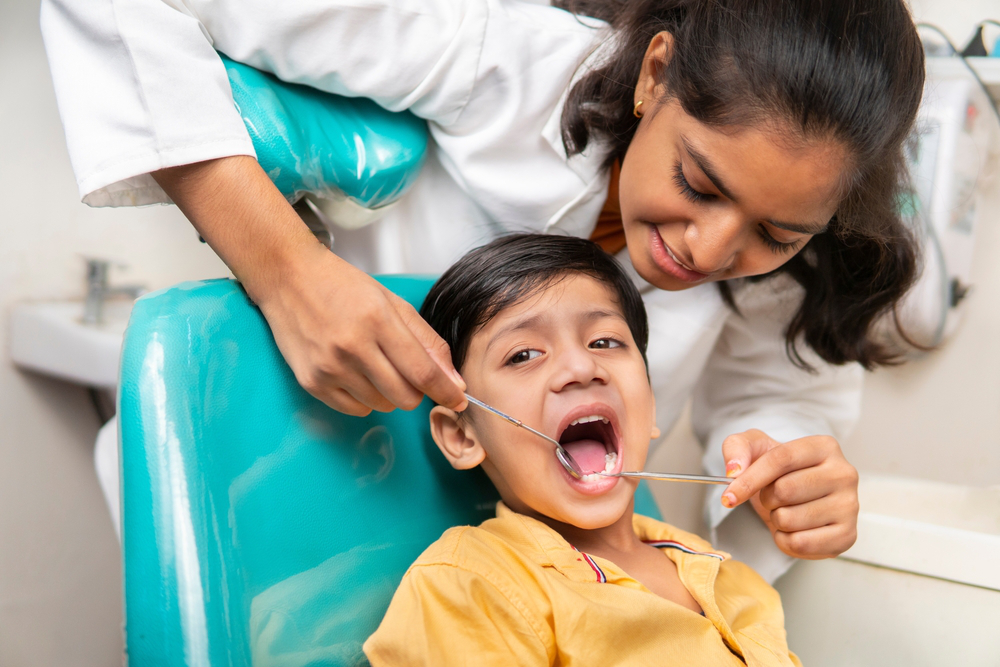
We use child-friendly language and gentle behavioural techniques, such as the “Tell-Show-Do” method, to demystify dental instruments. They first explain the tool in simple, imaginative words, show how it works on a finger or a stuffed toy, and then perform the procedure quickly and comfortably.
By focusing on building trust, patience, and fun, paediatric dentistry helps children view routine dental visits as a normal, positive part of staying healthy, completely eliminating the fear and phobia often associated with oral healthcare.
Managing Childhood Dental Emergencies
Children are naturally active, and dental trauma from playground falls, sports activities, or accidental collisions is incredibly common.
Immediate intervention and correct procedures prevent lifelong dental issues.
Routine use of custom-fitted sports mouthguards remains the single most effective way to protect your child’s smile from severe trauma during physical activities.
The Transition to Adolescence and Beyond
As children transition into their teenage years, their oral health needs shift dramatically, bringing new challenges that require specialized guidance.
Teenagers often experience an increase in cavities due to greater dietary independence, a higher consumption of sugary sports drinks or snacks, and occasional lapses in their daily brushing routines.
Furthermore, adolescence marks the period when the final permanent teeth emerge and wisdom teeth begin to develop deep within the jawbone. An essential time to monitor this final transition, providing tailored education on the dangers of oral piercings, the impact of smoking or vaping on gum tissue, and coordinating orthodontic referrals at the ideal biological window to achieve optimal structural alignment and aesthetic harmony.
Sedation Options: Calming the Anxious Child
Pediatric dentistry focuses on relaxing your child’s mind just as much as numbing their teeth. For children dealing with severe dental phobia, uncooperative behavior, or developmental needs, a range of safe, highly regulated sedation methods are available to create a peaceful, fear-free experience:
During early childhood, certain repetitive behaviours develop as natural self-soothing mechanisms.
Habits like thumb sucking, tongue thrusting, or prolonged pacifier use are completely normal in infants, they become highly destructive if they persist past the age of four. By this stage, a child’s facial bones and jaw structures are soft, highly malleable, and rapidly developing.
Habit breaking appliances are simple devices that intercept harmful patterns early, preventing permanent skeletal deformities and eliminating the need for invasive surgeries later in life
What do Habit Breaking Appliances Achieve?
The hidden physical forces at play during repetitive oral habits, for example, when a child constantly sucks a thumb or finger, the finger presses upward against the roof of the mouth while the cheeks squeeze inward, this continuous, unbalanced pressure acts as an artificial mould, narrowing the upper jaw arch and pushing the front teeth forward, this structural distortion creates a condition known as an open bite, where the top and bottom front teeth cannot touch even when the mouth is fully closed.
Similarly, tongue thrusting—where a child pushes their tongue forward against the teeth while swallowing—constantly drives the teeth out of alignment. Over time, these unchecked forces alter the physical shape of the jawbone, causing speech impediments, chronic mouth breathing, swallowing difficulties, and severe bite misalignments.
Habit breaking appliances are custom-made orthodontic devices engineered to gently and effectively disrupt these deeply ingrained, unconscious behaviours. They can be either removable or permanently fixed to the back molars for children who require continuous assistance.
These devices work through simple structural design rather than punishment or pain:
By physically neutralizing the habit, these appliances create a safe environment where the child’s jaw can naturally grow back into its correct, balanced shape.
Saving Time, Expense, and Discomfort
The primary reason to consider a habit breaking appliance early is prevention.
Intercepting a damaging oral habit between the ages of five and seven takes advantage of the child’s natural growth spurts. If the habit is broken early enough, the displaced front teeth will often guide themselves back into alignment naturally.
Neglecting these behaviours allows the jaw deformity to harden into a permanent skeletal defect once bone growth slows down.
Correcting an adult open bite or severe jaw mismatch requires years of complex fixed braces, tooth extractions, and expensive maxillofacial jaw surgery. Investing in a simple, non-invasive appliance today protects your child’s natural facial development and saves them from extensive discomfort down the road.
Myofunctional appliances are orthodontic devices that use the natural forces of the lips, cheeks, tongue, and jaw muscles to guide jaw growth and improve the relationship between the upper and lower jaws. They are most effective in growing children, especially during the mixed dentition or adolescent growth period.
Common types
Twin Block – Most commonly used removable appliance for Class II malocclusion.
Activator (Andresen Activator) – Encourages forward positioning of the lower jaw.
Bionator – Promotes balanced jaw growth and muscle function.
Frankel (Functional Regulator) – Uses soft tissue forces to guide jaw development.
Herbst Appliance – A fixed appliance that continuously holds the lower jaw forward.
Indications
Class II malocclusion (retruded lower jaw)
Increased overjet (“buck teeth”)
Mild skeletal discrepancies in growing patients
Oral habits such as mouth breathing or tongue thrust (in selected cases)
Growth modification during childhood and adolescence
Advantages
Helps modify jaw growth in growing children.
Can reduce the need for tooth extractions or jaw surgery in selected patients.
Improves facial profile and jaw relationship.
May improve oral muscle function and bite.
We always take care of your smile
+91 93629 05001
- Tirunelveli – Palayamkottai Market | Melapalayam | Karaieruppu
- Chennai – Kodambakkam
- Kanyakumari – Kuzhithurai Junction
Copyright © 2026 All Rights Reserved.